NEW HOME CONSTRUCTION IN WOODLAND HILLS: COSTS, PROCESS, AND WHAT TO EXPECT IN 2026
Building a new home in Woodland Hills requires navigating specific hillside ordinances, Title 24 energy codes, and LADBS permitting. Learn the 2026 cost ranges, timelines, and site factors that impact your custom build budget.

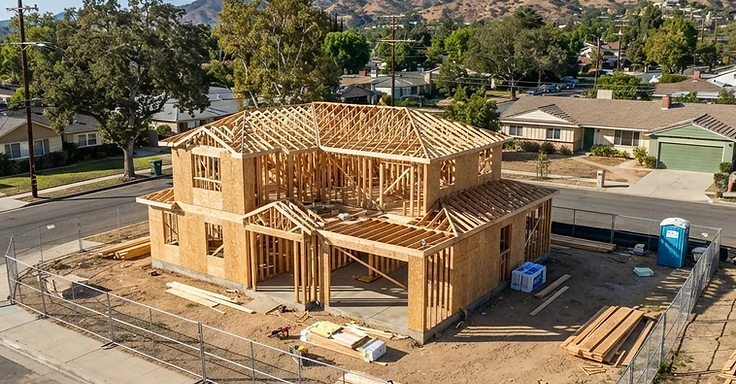
Building a new house in Woodland Hills is a different job than building one in Santa Monica or out in the Valley flats. The lots are bigger, many of them slope, the summer heat drives your Title 24 numbers, and the housing stock is mostly 1950s and 1960s ranch homes that people are now scraping and replacing. We build in this neighborhood constantly, so here is a straight answer on what it costs, how long it takes, and where projects get stuck.
Every number below is a planning estimate for budgeting, not a quote. Nobody can price a house without seeing your lot and your plans. Use these to figure out whether your project is in the right neighborhood financially, then get real numbers. If you are looking at a flat lot, you are generally looking at $400 to $550 per square foot for a well-built home with quality finishes. If you are building on a hillside, those costs jump significantly due to the geotechnical engineering and specialized foundation work required.
Key Takeaways
- Most new custom homes in Woodland Hills currently fall into a planning range of $400 to $650 per square foot for construction, excluding land costs.
- The total timeline for a new build, from initial design to final certificate of occupancy, typically spans 22 to 34 months.
- LADBS plan check and permitting processes for a new single-family home generally require 4 to 10 months of lead time.
- Hillside lots often require a soils and geology report, which can add $15,000 to $50,000 or more to your pre-construction budget.
- You must comply with the latest California Energy Code, which mandates specific solar, insulation, and HVAC efficiency standards for all new residential construction.
What a new home in Woodland Hills costs in 2026
Budgeting for a new home is about understanding the variables that live outside the simple per-square-foot number. While you might see base construction costs starting around $400 per square foot, that figure rarely includes the soft costs that make up a significant portion of your total investment. You need to account for design and engineering, which typically run 6 to 12 percent of your construction budget. This covers your architect, structural engineer, and the necessary Title 24 energy compliance reports.
Permits and city fees are another major line item. In the City of Los Angeles, you should plan on $40,000 to $90,000 for plan check, school fees, sewer connection, and park fees. If you are tearing down an existing structure, add $25,000 to $60,000 for demolition, assuming there is no asbestos abatement or pool removal required. Site work is the ultimate wild card. On a flat lot, you might spend $50,000 on utilities and grading, but on a difficult hillside lot, that number can easily climb to $400,000. Always keep a contingency fund of 10 to 15 percent for flat lots and 15 to 20 percent for hillside projects to cover the inevitable surprises that appear once you start digging.
The realistic timeline for custom construction
Homeowners are often surprised by how much of a new build happens before anyone swings a hammer. The process in the City of Los Angeles is rigorous and requires patience. It starts with a feasibility and lot review, which takes 2 to 4 weeks. During this phase, we analyze zoning, setbacks, height limits, and hillside status to tell you exactly what you are allowed to build before you spend money on full architectural plans.
Once feasibility is confirmed, you move into design and engineering, which takes 3 to 6 months. This includes schematic design, construction documents, and the necessary energy and soils reports. After that, you enter the plan check and permitting phase with the Los Angeles Department of Building and Safety. This stage takes 4 to 10 months as your plans move through Building and Safety, Planning, Fire, and the Bureau of Engineering. Finally, actual construction takes 12 to 18 months. Anyone promising a new custom home in twelve months from day one is likely ignoring the reality of the permitting process.
Permitting and LADBS requirements
A new single-family dwelling in Woodland Hills goes through the LADBS, most commonly the Van Nuys development services center. Understanding the local rules is critical to avoiding delays. If your lot is mapped as a Hillside Area, your allowed floor area is tied to the slope of the lot, not just the size. This means two neighbors with identical lot sizes can be allowed very different house sizes. You should also be aware of the Baseline Hillside Ordinance, which dictates height and setbacks in ways that often surprise homeowners who are used to flat-lot rules.
If you plan to export more than 1,000 cubic yards of dirt, you will trigger a haul route approval, which requires a public hearing and can add several months to your timeline. Furthermore, much of the hillside area in Woodland Hills is in a Very High Fire Hazard Severity Zone. This requires compliance with Chapter 7A of the building code, meaning you must use ember-resistant vents, Class A roofing, and dual-glazed tempered windows. You can find more information on these requirements through the LADBS building permit portal.
Site and hillside factors that move your budget
On a flat lot in the Warner Center area or south of Ventura Boulevard, site work is generally predictable. However, once you move into the canyons or up toward Mulholland, the site becomes the project. The slope percentage is the primary driver of cost. Anything past 15 percent slope usually necessitates stepped foundations, caissons, and grade beams. These structural requirements are non-negotiable and significantly more expensive than a standard slab-on-grade foundation.
Access is another hidden cost. Narrow canyon streets often limit the size of trucks that can reach your property. This means smaller loads, more trips, and the potential need for a concrete pump or crane, all of which add to your labor and equipment costs. You also need to consider drainage. LA rain arrives all at once, and the city requires a proper stormwater plan, including area drains and swales, to protect your home and the surrounding property. Finally, be aware of protected trees. Native oaks and sycamores are strictly protected in Los Angeles. Building near one triggers a mandatory tree report and can force you to redesign your footprint to maintain the required protection zone.
How we run a design-build new home
We approach your Woodland Hills project as one team from start to finish. In the old way of building, you would hire an architect, wait six months for plans, then go out to bid only to find out the design costs 500,000 dollars more than you have. We fix that by putting the builder and the architect at the same table from day one. When we draw a floor plan, we are pricing the materials and labor at the same time. This keeps the design within your actual planning budget range. We start with a deep look into your lot's specific data, looking at the Contractors State License Board status of all subs and ensuring every part of the plan is buildable.
Once the concept is set, we move into the heavy lifting of engineering and permits. We coordinate the structural engineer, the civil engineer, and the soils experts. You do not have to play middleman between four different consultants who are not talking to each other. We handle the back and forth with LADBS plan checkers in Van Nuys. While your project is in plan check, we are already lining up vendors and finalizing your interior selections. This way, the second that permit is issued, we are ready to move equipment onto the site. Throughout the build, you get access to a digital portal where you can see daily logs, photos, and the schedule. You will know exactly what is happening on your lot every day without having to drive over there and check. We keep the process direct so there are no surprises when it comes time for inspections or final sign-offs.
Where to save and where not to
When you are looking at a 1.5M dollar or 2M dollar planning budget, it is tempting to look for places to cut costs. The trick is knowing which cuts save money now but cost you ten times more later. One of the smartest places to save is in the footprint and roofline. Every corner you add to a house increases framing and foundation costs. A simple, elegant rectangular or L-shaped house is much cheaper to build than one with twenty different wall offsets. You can also save by choosing high-quality, mid-range finishes for secondary bathrooms and guest rooms while spending your money on the kitchen and primary suite where it adds the most value.
On the other side, there are things you should never go cheap on in Woodland Hills. Do not skimp on your HVAC system. This neighborhood hits 110 degrees in the summer, and an undersized or poorly designed cooling system will make your life miserable and your electric bill skyrocket. You also should not cut corners on waterproofing or the foundation, especially on a hillside. Fixing a foundation crack or a subterranean leak after the house is finished is a total nightmare. Spend the money on high-quality windows and doors too. They are the most used parts of your home and they are essential for your energy rating. You can always upgrade a light fixture or a carpet in five years, but you cannot easily replace the bones of the building or the insulation inside the walls once the drywall is up. Invest in the things that are permanent and save on the things you can touch up later.
Navigating Title 24 and energy efficiency
California has some of the strictest energy codes in the country, and Woodland Hills presents a specific challenge because it sits in Climate Zone 9. The California Energy Commission sets these Title 24 standards to reduce the load on the power grid. For a new build in 2026, this means you are looking at a mandatory solar array and likely battery storage. You also have to use high-efficiency heat pumps for heating, cooling, and water heating. The city is moving away from natural gas, so most new homes we build here are now all-electric.
To make these systems work without costing a fortune in monthly utilities, we focus on the building envelope. This means using cool roofs that reflect sunlight and advanced insulation techniques like spray foam or continuous exterior insulation. We also look at window orientation. In Woodland Hills, you want to be careful with massive west-facing glass unless you have significant overhangs or high-performance coatings, because the afternoon sun will bake your living room. A well-designed energy plan does not just check a box for the city, it makes the home much more comfortable. When your house is tightly sealed and properly insulated, the temperature stays stable and you do not hear the noise from the street or the neighbors. It is a win for your wallet and your quality of life. We make sure your Title 24 report is integrated into the design from the start so you do not have to make ugly changes at the last minute to satisfy the state.
Ready to price your lot?
Woodland Hills is a unique market because of the variety of lots. You might have a perfectly flat 8,000 square foot lot in the flats or a two-acre vertical cliff near Topanga State Park. Before you buy a property or start a design, you need a feasibility study. We look at the zoning code, the Specific Plan requirements if you are in a protected area, and the Baseline Hillside Ordinance. We also check for easements and utility access. Sometimes a lot looks like a bargain until you realize the sewer main is 300 feet away and requires a public works permit to reach.
We help you understand the true cost of the land by looking at what it takes to get it ready for a house. If you are looking at a lot with five protected oak trees, your buildable area might be half of what you think it is. If the soil is expansive clay, your foundation will need extra steel and deeper footings. We take all these factors and put them into a realistic planning budget. This is not a guess, it is based on current labor rates in Los Angeles and the prices we are seeing from local suppliers. Having this information early prevents you from getting halfway through design only to realize the project is not financially viable. We want you to go into your build with your eyes wide open about the costs and the timelines so you can enjoy the process of creating your new home.
How 1 Smart Build can help
Building a custom home is likely the biggest investment you will ever make, and you need a partner who knows the local dirt, the local codes, and the local inspectors. At 1 Smart Build, we specialize in navigating the complexities of Los Angeles construction. We take the stress out of the process by managing every detail from the first sketch to the final coat of paint. Whether you are building a modern farmhouse in the flats or a contemporary hillside retreat, we have the experience to get it done right and on schedule.
If you are ready to take the next step, we are here to help. You can call us at 1 (866) 419-8840 to talk about your project and get your questions answered by a pro. We can also perform a detailed site analysis to help you understand the potential of your property. Visit our build check page to submit your address and get started. We look forward to helping you build a home that fits your life and stands the test of time in Woodland Hills.
DISCUSS YOUR PROJECT WITH 1 SMART BUILD
Licensed, bonded and insured design-build general contractor serving Los Angeles County and Southern California. Tell us about your property and goals, and we'll walk you through feasibility, permitting and a clear plan.