CUSTOM HOME BUILDER IN WOODLAND HILLS: COSTS, PROCESS, AND HOW TO CHOOSE
Building a custom home in Woodland Hills requires navigating complex hillside ordinances, fire zone regulations, and the Los Angeles Department of Building and Safety. Learn the 2026 cost ranges, the step-by-step construction process, and how to vet a contractor for your project.

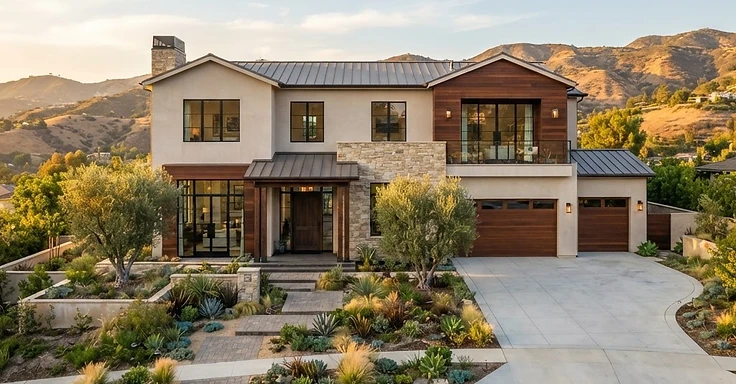
Building a custom home in Woodland Hills is one of the most rewarding and demanding projects you can take on. You are not just choosing finishes; you are navigating hillside lots, Los Angeles plan check, seismic and energy codes, and a build that can run twelve to twenty-four months. The builder you choose determines whether that process feels controlled or chaotic. Here is how to choose a custom home builder in Woodland Hills, what the process actually involves, what it costs in 2026, and the questions that separate a real builder from a risky one.
Woodland Hills sits at the western edge of the San Fernando Valley, with a mix of flat valley-floor lots and hillside parcels climbing toward the Santa Monica Mountains. That geography shapes everything. A flat lot near Ventura Boulevard is a relatively straightforward build, but a sloped lot above Mulholland can mean caissons, retaining walls, grading permits, and a geotechnical soils report before you ever pour a foundation. You need a partner who understands these specific site constraints.
On top of terrain, you are building inside the City of Los Angeles, which means plan check and inspections run through the Los Angeles Department of Building and Safety (LADBS). Woodland Hills also sits in a Very High Fire Hazard Severity Zone in many areas, which triggers stricter requirements for ignition-resistant materials, defensible space, and often fire sprinklers. A builder who works the Valley regularly knows these rules cold. One who does not will learn them on your dime.
Key Takeaways
- Custom home construction in Los Angeles typically ranges from $400 to $1,500+ per square foot depending on site complexity and finish levels.
- A contingency of 5% to 10% of the total construction budget is recommended to account for unforeseen site conditions or design adjustments.
- Hillside construction projects in Los Angeles often require 6 to 18 months for permitting alone, compared to 3 to 6 months for standard flat-lot projects.
- You must verify that your contractor holds an active B-General Building license and current workers' compensation insurance via the CSLB license check.
- Hillside ordinances in Los Angeles may limit grading to 500 cubic yards plus 5% of the lot size unless specific variances are obtained.
Why Building in Woodland Hills Is Different
The primary difference between building in Woodland Hills and other parts of the country is the sheer variety of topography. If you are looking at a lot south of the Boulevard, you are likely dealing with the Santa Monica Mountains. This means your project is subject to the Hillside Ordinance, which dictates everything from how much dirt you can move to the width of the street providing access to your property. If the street frontage is less than 20 feet wide, you may face additional requirements for street improvements or fire department access clearances.
Beyond the physical slope, the regulatory environment is intense. Because much of Woodland Hills is designated as a fire hazard zone, your exterior materials must meet strict ignition-resistant standards. This affects your choice of siding, roofing, and even the types of vents you install. You cannot simply pick the aesthetic you want; you must pick an aesthetic that complies with the local fire code. A builder who is not familiar with these specific LADBS requirements will likely face significant delays during the inspection phase, as they may have to rip out and replace non-compliant materials.
Finally, the soil conditions in the hills are notoriously variable. You will almost certainly need a professional soils report to determine if you need a standard spread footing or a deep caisson foundation system. These systems are expensive and require specialized equipment. If your builder has not managed a project with caissons before, they will struggle to coordinate the drilling, steel reinforcement, and concrete pouring required to keep your home stable. You need a builder who treats the geotechnical report as the foundation of the entire project, not just a piece of paperwork to be filed away.
What a Custom Home Costs in Woodland Hills (2026)
Custom home pricing is driven by lot conditions, size, and finish level far more than by any flat per-square-foot number. While you will see broad ranges online, you need to understand what those numbers actually cover. In 2026, a standard custom build on a flat, buildable lot typically ranges from $400 to $650 per square foot for a well-built home with quality finishes. If you are aiming for luxury, high-end finishes, custom millwork, and designer fixtures, that range easily climbs to $700 to $1,500+ per square foot.
Hillside lots add a massive layer of cost before the house even starts. Grading, caissons, retaining walls, and complex soils work can add $150,000 to $500,000 or more to your budget depending on the slope and site access. These are hard costs that do not make your kitchen look any nicer, but they are essential for the structural integrity of your home. You should also account for soft costs, which include architectural design, structural engineering, Title 24 energy calculations, and permit fees. These typically add another 15% to 25% on top of your construction costs.
Two homes of identical size can differ by seven figures based purely on lot and finish decisions. This is exactly why a per-square-foot quote given before anyone has seen your lot or plans is close to meaningless. A real builder prices from a defined scope, not a guess. Always ask for an open-book approach where you can see the actual costs of materials and labor, rather than a lump-sum bid that hides the builder's margin and potential for change orders.
The Custom Home Building Process, Step by Step
The process begins with feasibility and lot analysis. Before you hire an architect, a good builder assesses what your lot can actually support. This includes checking zoning, setbacks, height limits, hillside ordinance constraints, and utility access. Many projects are reshaped or abandoned at this stage because the cost to build on a specific lot exceeds the potential value of the home. Do not skip this step.
Once the feasibility is confirmed, you move into design and engineering. This is where architectural plans, structural engineering, and energy calculations come together. A design-build contractor coordinates design and construction pricing in parallel, so you never fall in love with a set of plans you cannot afford to build. This integrated approach saves you from paying for redesigns after you have already spent thousands on initial plans.
After the design is finalized, the plans go through LADBS plan check. For a full custom home, this commonly takes two to four months, though it can take much longer for hillside or fire-zone complexity. Corrections and resubmittals are normal. An experienced builder anticipates these corrections and prepares the plans to minimize the back-and-forth with the city. Once the permit is issued, site work and foundation begin. On hillside lots, this is the highest-risk phase. Grading, caissons, and footings must be poured and inspected with precision. If the foundation is not perfect, every subsequent phase of the build will suffer from alignment issues. Finally, you move into framing, rough-in, and finishes. Every phase requires a sign-off from a city inspector, and a good builder manages these inspections to ensure the project never stalls.
How Long Does It Take to Build a Custom Home?
For a full custom home in Woodland Hills, you need to be realistic about the timeline. Anyone promising a ground-up custom build in under a year is likely underscoping the work. Design and engineering typically take 3 to 6 months. Permitting and plan check usually take 2 to 4 months, but this can easily stretch to 6 to 18 months for complex hillside projects that require multiple agency clearances.
Construction itself takes 10 to 16 months for a standard home, while large or complex hillside builds often run 16 to 24+ months. Realistically, from your first meeting to the day you move in, most Woodland Hills custom homes take eighteen months to two-plus years. Delays are often caused by late finish selections, weather-related issues on hillside sites, or slow responses from city departments during the inspection process.
To keep your project on track, you must make your major finish decisions early. If you wait until the framing is done to pick your tile, flooring, or cabinetry, you will inevitably face delays. A professional builder will provide you with a selection schedule that tells you exactly when you need to make each decision to keep the project moving. If you miss these deadlines, you are the one causing the delay. Stay organized, keep your communication with your project manager frequent, and expect that a project of this scale will have a few bumps in the road. The key is having a builder who knows how to navigate those bumps without stopping the entire project.
Key Takeaways
Building a custom home in Woodland Hills requires a specific understanding of the local environment and regulations. First, you must accept that the cost is a moving target until your plans are finalized. For a standard custom build on a flat lot, plan for $400 to $650 per square foot. If you are building on a hillside, that number can climb toward $1,500 per square foot because of the structural demands of the land. You should always keep a contingency fund of at least 10% of the total construction budget. This money is not for upgrades; it is for the surprises that happen when you start digging in the San Fernando Valley soil or when the city requires a specific change during the inspection process.
Second, timing is not just about how fast a crew can work. It is about how fast the city moves. Permitting for a standard lot might take a few months, but hillside projects often face a wait of six to eighteen months for all clearances. You also need to verify your builder's credentials before you pay a single dollar. An active B-General Building license is mandatory, and you can check this status on the CSLB license check website. Never hire someone who uses a sub-license or whose insurance has lapsed. Finally, remember that Woodland Hills is a fire hazard zone. This means you must follow strict rules for exterior materials. You cannot use just any siding or roofing; everything must meet ignition-resistant standards to ensure your home is safe and compliant with current California codes. If you ignore these takeaways, you risk long delays and massive cost overruns.
How to Choose a Custom Home Builder in Woodland Hills
Choosing a builder is the most important choice you will make in this entire process. You aren't just looking for someone who can swing a hammer; you're looking for a project manager who can handle the City of Los Angeles bureaucracy. Start by looking for local experience. A builder who primarily works in Orange County or even just across the hill in Santa Monica might not be familiar with the specific inspectors at the LADBS Van Nuys office. You want someone who knows the local rhythms and the specific quirks of Woodland Hills geography. Ask to see projects they've finished in the San Fernando Valley within the last three years. If they can't show you a finished home that looks like what you want, they are not the right fit.
You also need to look at how they handle their business. A professional builder will have a clear, written process for how they manage your money. You should avoid any contractor who asks for a massive upfront deposit that exceeds California legal limits (usually $1,000 or 10% of the contract price, whichever is less). Look for a builder who uses an open-book pricing model. This means you see the actual invoices from the lumber yard and the subcontractors, and the builder adds a transparent fee for their management and overhead. This prevents the builder from hiding extra profit inside a vague lump-sum bid. You also need to confirm their insurance status. They should have general liability insurance and workers' compensation for every person who steps onto your property. If a worker gets hurt and the builder isn't insured, that liability could fall on you as the property owner. Don't take their word for it; ask for a certificate of insurance that lists you as an additional insured party. This is a standard request for any professional outfit.
Finally, pay attention to communication. A custom build is a relationship that lasts one to two years. If the builder is hard to reach during the sales process, they will be impossible to find when there is a leak or a permit issue. You need a single point of contact who answers your texts and emails within a reasonable time. You aren't just buying a house; you're buying their ability to solve problems on your behalf. If you don't feel like you can trust them with your life savings, don't sign the contract. The best builder is the one who tells you the truth about costs and timelines, even when that truth is something you don't want to hear. Avoid the people who say everything will be easy, because in Woodland Hills construction, nothing is ever simple.
Questions to Ask Before You Sign
Before you put your signature on a construction contract, you need to conduct a thorough interview. Start with the basics of their license. Ask them directly for their CSLB number and verify it yourself. Then, move into the specifics of your project. If you have a hillside lot, ask them, "How many caissons did you have to drill on your last project, and what were the soil conditions like?" A builder who has done the work will be able to talk about the depth of the piers and the challenges of the concrete pour. If they give you a vague answer, they probably haven't managed a complex hillside build before. You should also ask about their relationship with subcontractors. A good builder has a steady crew of plumbers, electricians, and framers they've worked with for years. If they're just hiring whoever is cheapest on Craigslist that morning, your quality will suffer.
How 1 Smart Build Can Help
1 Smart Build is a licensed design-build general contractor in Woodland Hills (CSLB #1076428) working across Los Angeles County. We handle design, permits, structural work and finishes under one contract, so you have one team accountable for the schedule and the budget. Call 1 (866) 419-8840 or run a free feasibility check on your property at /build-check to see what your lot allows.
DISCUSS YOUR PROJECT WITH 1 SMART BUILD
Licensed, bonded and insured design-build general contractor serving Los Angeles County and Southern California. Tell us about your property and goals, and we'll walk you through feasibility, permitting and a clear plan.